

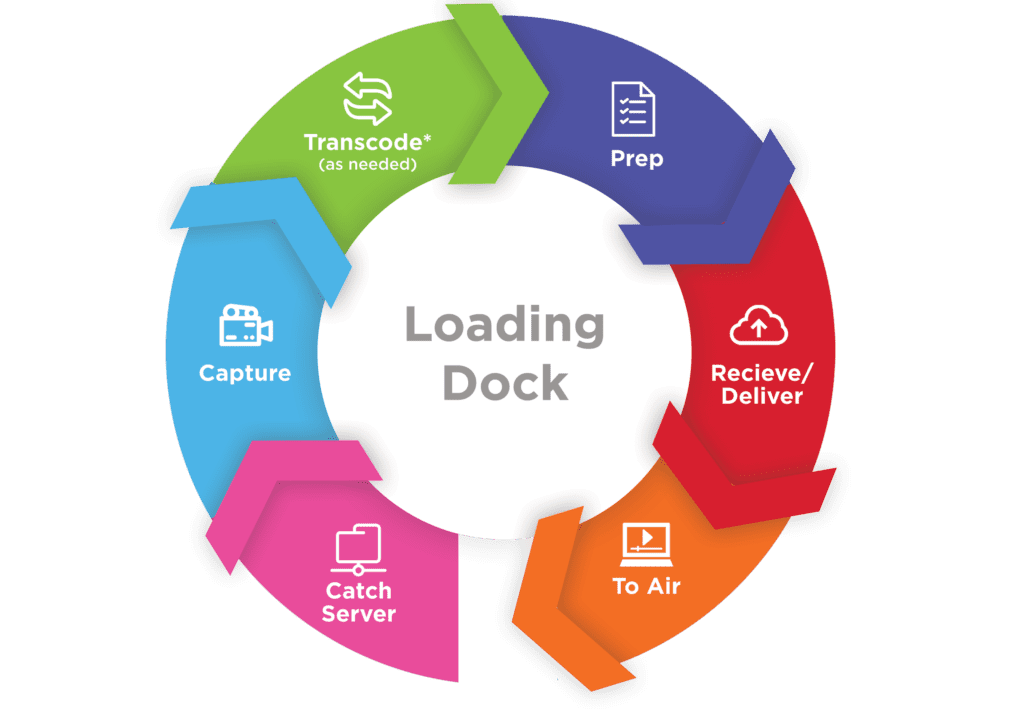
Crispin LoadingDock is a central component of many facilities’ master control infrastructure. It provides file-based content ingest, primarily for media delivered by syndicated content providers.
LoadingDock enables users to register and manage content from multiple sources through a single, browser-based interface accessible from anywhere on the network, including:
- Content providers
- FTP sites
- Network watch folders
This streamlined approach simplifies the ingest process and provides a unified workflow for managing incoming media assets.
Transcoding Considerations
Although transcoding is commonly incorporated into a LoadingDock workflow, it is not a requirement. Crispin does not provide transcoding services directly; however, there are multiple options available for integrating third-party transcoding solutions into the overall content ingest process.
Determining Transcoding Requirements
Each facility should evaluate its own transcoding requirements based on operational needs, including:
- Production workflows
- Playout requirements
- Content delivery specifications
- Storage and bandwidth considerations
From LoadingDock’s perspective, the content format is generally not critical as long as the destination playout server supports the media format. However, transcoding is often used to create a low-resolution proxy file that can be used for content preparation and review within the browser interface.
Is a Low-Resolution Proxy Required?
No. A low-resolution proxy is not required for LoadingDock operation.
LoadingDock can be configured to control the video server directly without generating proxy files. However, this changes the traditional workflow for bringing content into the system.
Workflow Shifts
Crispin supports alternative workflows that may reduce or eliminate transcoding requirements.
Historically, content was only transferred to the video server after it had been prepared and approved via the proxy video embedded within the browser prep tool. By preparing content directly through a video server port, facilities can eliminate the need to generate a proxy version, reducing the overall transcoding load.
Many video servers can accept a variety of file formats natively. Some servers also offer additional services to address format discrepancies, such as content rewrapping.
This approach can significantly reduce infrastructure requirements in environments where the playout platform already supports the delivered media formats.
Reducing Transcoding Requirements
In some cases, transcoding capacity can be reduced by requesting content from providers in formats that are already compatible with the facility’s playout environment.
While this may not be possible for all content providers, many distributors offer multiple delivery formats and may accommodate specific format requests.
By reducing the overall transcoding load, customers can configure profiles that generate only a proxy asset for review, avoiding the processing overhead of a full transcode and reducing content turnaround times.
Third-Party Transcoding Integration
Transcoding options are available through third-party vendors. Crispin is committed to supporting customer requirements and is willing to evaluate any vendor, upon request, for possible integration into the overall workflow.